
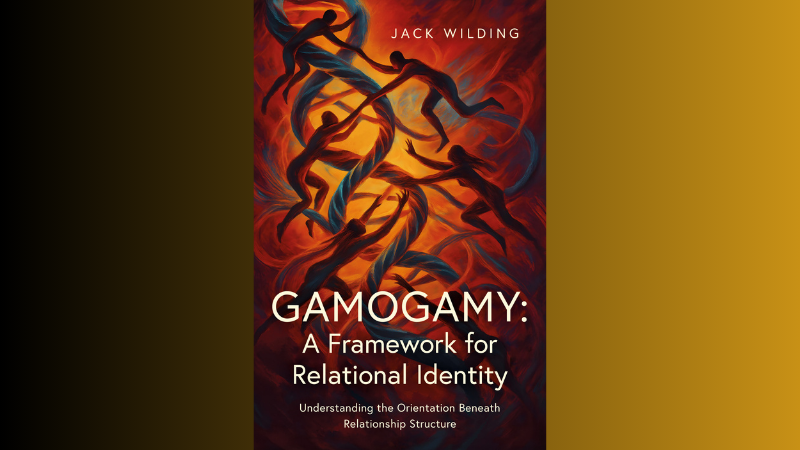
Inside Gamogamy: A New Language for Modern Relationships – Relationships have long been explained through the familiar lenses of monogamy, polyamory, attachment styles, and behavioural psychology. But what if something fundamental has been missing from that conversation entirely?
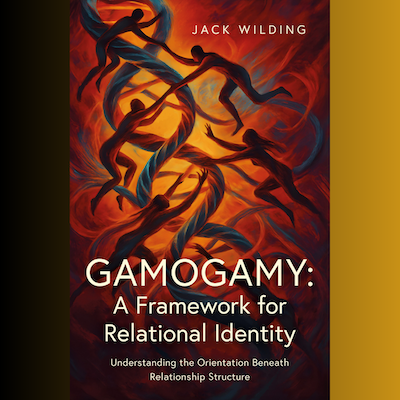
In Gamogamy: A Framework for Relational Identity, systems engineer and author Jack Wilding proposes a strikingly different way of understanding human connection—one that suggests our struggles in relationships may not always be about choice, morality, or even compatibility, but about an overlooked aspect of identity itself.
Drawing on systems thinking and AI-driven pattern recognition, Wilding introduces the concept of “relational orientation,” arguing that people may be inherently structured toward a certain number of concurrent intimate bonds. His framework challenges long-held assumptions about fidelity, commitment, and emotional failure, offering instead a new language for patterns of love and conflict that traditional psychology has struggled to fully explain.
In this interview, we explore the ideas behind Gamogamy, the thinking that shaped its development, and the implications it may have for how we understand ourselves and the relationships we build.
What first made you suspect existing frameworks were missing something?
It started with a simple question: why do people who genuinely love their partner cheat? And more specifically, why do some people with a history of doing it keep repeating the pattern?
Are they simply “bad people”? Maybe. But these are often individuals who are otherwise stable and responsible—loyal friends, caring parents, honest in most areas of life. And yet, repeatedly, they feel drawn to others and act on it.
Are they broken? Or is the system they’re trying to inhabit incomplete?
That was the question that made me look deeper than surface explanations.
How did your background lead to Gamogamy, and what surprised you?
I approached it the way I would any system, strip out the narrative and look at what the patterns are actually doing.
What surprised me wasn’t that differences existed; I expected that. It was how clean the separation is. Once you observe behaviour under different conditions, especially stress and freedom, the clustering becomes very clear. There’s very little noise once you remove the story people tell themselves.
People will describe one version of themselves. Their behaviour under pressure often tells a different one. That isn’t cynicism, it’s just what emerges when you apply systems thinking to human behaviour.
How do you distinguish true orientation from behaviour shaped by culture or guilt?
True orientation persists even when it “shouldn’t.”
Think back seventy-five years. A homosexual man in a heterosexual marriage because that’s what society required. The cultural expectation was clear. The guilt was real. The pressure to conform was overwhelming.
And yet the underlying pattern still surfaced, often in secret, often in conflict with itself, but it surfaced nonetheless.
That’s the signal. Not what someone chooses when conditions are ideal, but what continues to emerge despite pressure, expectation, and suppression. That’s where orientation reveals itself.
What does this mean for therapy and relationship advice?
It means we are often solving the wrong problem.
Most relationship work focuses on helping two people function better within a given structure: better communication, clearer boundaries, improved honesty. And sometimes that’s exactly what’s needed.
But what if the structure itself is misaligned with the people inside it? That’s a question many systems don’t ask. Gamogamy does.
Is this the right relational shape for who these people actually are? That’s a more difficult question, but often a more useful one.
How do you hope readers respond?
I want them to feel recognised before they feel challenged.
Most people who engage with this idea are already carrying something, a pattern they can’t explain, a sense of inconsistency between intention and behaviour, or a quiet confusion about why something keeps repeating.
Gamogamy isn’t asking anyone to become something new. It’s offering language for something they may already recognise in themselves.
Some will reject it entirely, and that’s fine, it either resonates or it doesn’t. But others may feel a kind of clarity or relief at being described accurately for the first time.
That’s what it’s designed to do. What they do with that recognition is entirely their own.
Jack Wilding’s Gamogamy offers a provocative reframe of something deeply personal and often painful: why relationships succeed, strain, or break apart despite genuine care and intention. By introducing the idea of relational orientation, he challenges readers to reconsider whether some of the patterns we label as failure might instead be expressions of an unrecognised internal structure.
Whether embraced as a groundbreaking lens or questioned as a radical departure from established psychology, Gamogamy opens up a broader conversation about identity, desire, and the complexity of human connection. At its core, it invites us to ask not just how we love, but whether we have ever truly had the right language to understand how we are built to love at all.
For more information, visit Troubador Publishing.
Poppy Watt
#Competition
We have 1 copy of the book Gamogamy to give away.
Here’s How to Enter:
- Follow the Women Talking Instagram Account
- Like & share the post.
- Make a COMMENT, stating why you would like to win – Anyone who comments will be entered into the prize draw to win.
- This competition has now closed.
GOOD LUCK!
*The editor’s decision is final and there is no cash alternative
*The competition is open to UK residents only.
*The winner will be chosen at random and notified on Instagram within 7 days of the contest closing date.
*This promotion is in no way sponsored, endorsed, or administered by, or associated with, Instagram.
*The winner will be contacted by DM on social media.