Choosing a Name Necklace: Script, Finish and Metal Explained – A name necklace looks simple. It’s a few letters on a chain. But the choices behind it (the style of the lettering, the colour of the metal, the way the piece is made) change how it looks and how it feels to wear. This guide covers what to think about before you order one, using the options at YOVA as a concrete example.
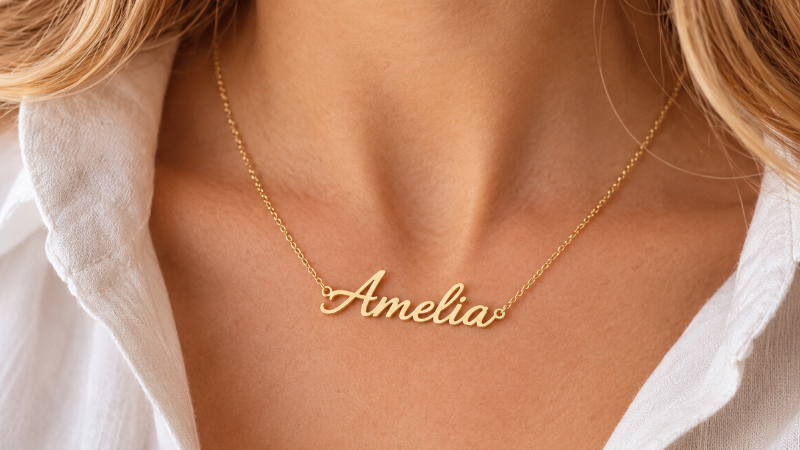
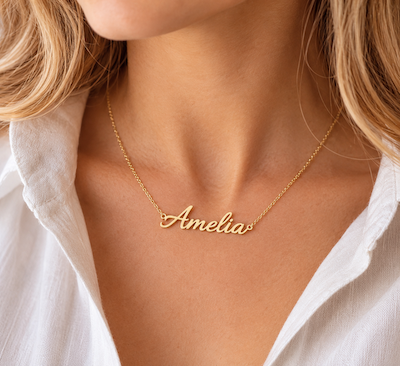
Close-up of a personalised name necklace worn at the collarbone
Image suggestion: a close-up of a name necklace in gold-plated finish, worn at the collarbone. Alt text: “Personalised name necklace in a cursive script on a fine chain.”
Why name necklaces keep coming back
Jewellery trends move quickly, but the name necklace has stayed in circulation for decades. The reason is fairly plain: it’s personal in a way few accessories are. A birthstone says something about a month. An initial says something about a letter. A full name says something about a person.
People wear them for different reasons. Some choose their own name because they like how it looks. Others choose the name of a child, a partner, a grandparent or a close friend, so that someone they love is always close. Some pick a nickname, a word in another language, or a short word that matters to them. The format is flexible, and that flexibility is a large part of its appeal.
Because the piece is built around letters, the style of those letters matters a great deal. A name in a flowing script reads very differently from the same name in clean capitals. That is where most of the decision-making happens.
Start with the metal: 925 sterling silver
Before you think about the look of the lettering, it helps to know what the necklace is made of. The necklaces discussed here are made in 925 sterling silver. The number 925 refers to the proportion of pure silver in the alloy: 92.5 percent, with the remainder usually made up of other metals that add strength. Pure silver is quite soft, so a small amount of alloying metal makes the piece sturdier for everyday wear.
Sterling silver is a common choice for personal jewellery for a few reasons. It has a bright, cool shine. It takes plating well, which matters for the finishes below. And it is a precious metal rather than a plain base metal, which many people prefer for something that sits against the skin every day.
On the site, necklaces start from €35. Prices are shown in local currency, so you don’t have to convert anything yourself when you look at the total.
Two plated finishes: gold and rose gold
Silver is lovely, but not everyone wants a silver-coloured necklace. That’s where plating comes in. Plating means a thin layer of gold or rose gold is applied over the silver base. You get the warmth of a gold tone while the piece underneath is still 925 sterling silver.
The options here are gold-plated and rose gold-plated.
Gold-plated gives a classic yellow-gold tone. It tends to suit people who already wear gold jewellery, and it often looks good against warmer skin tones and against tanned skin. It also pairs easily with other gold pieces such as a ring, small hoops or a watch.
Rose gold-plated has a pinkish, softer tone. It’s popular with people who find yellow gold a little too bold and silver a little too cool. Rose gold often looks flattering across a wide range of skin tones, and it has a gentle, slightly romantic feel.
A practical note on plating in general: because the gold layer is thin, it can wear over time, especially with friction, perfume, lotions, chlorine and sweat. Many people take their jewellery off before swimming, showering or exercising, and put it on after applying skincare and perfume. It’s a small habit that helps any plated piece last longer.
Six scripts, six personalities
The most interesting decision is the lettering. The site offers six scripts for the necklace: Ronde, Plume, Douce, Calligraphy, Capitals and Volute. Each gives a different result even with the same name, so it’s worth thinking about what you want the necklace to say about the wearer.
Ronde
As the name suggests, Ronde is built around rounded shapes. Rounded letters tend to feel friendly and approachable. If you want a necklace that feels relaxed and easy to wear day to day, a rounded script is a natural place to look. It also reads clearly, which helps with names that have many letters.
Plume
Plume brings to mind a quill, and that is a useful way to picture it: light, flowing strokes with a handwritten feel. This is the kind of lettering that looks like a signature. It works well for people who like a delicate, slightly elegant look without too much visual weight.
Douce
Douce means soft or gentle in French, and the script lives up to the word. Think of a calm, smooth style that doesn’t draw attention to itself. If you prefer understated jewellery, Douce is worth previewing, especially for a short name where every letter is visible.
Calligraphy
Calligraphy is the most traditional of the six in feel. It echoes formal handwriting, with the contrast and flourish you associate with invitations and certificates. It suits people who like a refined, classic look, and it can make even a short name look intentional and ornate.
Capitals
Capitals is the straightforward option: uppercase letters, clean and clear. It’s a good choice if you like a modern, minimal look or want a name to read instantly. Capital letters also work well for initials, short words, or names that you want to look bold and graphic rather than flowing.
Volute
A volute is a spiral or scroll shape, and the word is often used in architecture and decorative design. The script carries that sense of curl and ornament. It’s for someone who wants more personality in the lettering and doesn’t mind a decorative flourish.
None of these is right for everyone. A long name in a very ornate script can be harder to read, while a very short name in capitals may feel stark to some people and clean to others. The best approach is to compare, and that’s where the next feature helps.
See it in 3D before you order
One of the more practical features on the site is the preview. The name is drawn in 3D as you type it, so you see the piece before you order it.
This solves a real problem with personalised jewellery. When you order something with a name on it, you can’t easily return it and swap it for another, because it was made for you. So it matters that you can see what you’re buying. Typing the name and watching it appear in the chosen script lets you check several things at once:
- Spelling. It sounds obvious, but a typo in a personalised piece is an annoying mistake. Seeing the name in front of you is a good moment to check each letter.
- Proportions. Some names look balanced in one script and cramped in another. Long names in particular can behave very differently from short ones.
- Readability. Certain letter combinations are harder to read in flowing scripts. A quick look will tell you whether the name is clear.
- Capital letters and spacing. If you’re unsure whether to use a capital first letter, or a single name rather than a full one, you can try both and compare.
A good habit is to test the same name in all six scripts one after the other. It takes a minute or two, and you’ll often find that your favourite isn’t the one you assumed at the start.
Choosing the name itself
The lettering and finish come after a more basic decision: what goes on the necklace.
Your own first name is the most common choice, and for good reason. It’s simple and it always makes sense.
A loved one’s name works well if you want to carry someone with you. Parents often choose a child’s name, and some people choose the name of a partner or a sibling.

A nickname or short word gives you more freedom. A pet name, a family nickname, or a word that holds meaning can look just as good as a formal name, and sometimes it’s more personal.
A name in another alphabet or with accents is worth testing in the preview, since special characters can look different from one script to another. If your name includes accents or unusual letters, type it in and check each script.
Short names tend to look lighter and more delicate. Longer names make more of a statement, and you may want to choose a more legible script for them. Neither is better; they are just different looks.
Matching the necklace to how you dress
It helps to imagine the necklace on a normal day, not just on a screen. A few simple pairings:
- If you mostly wear plain tops and everyday basics, a rounded or soft script in either finish will blend in without effort.
- If you wear a lot of gold jewellery already, the gold-plated finish will match what you own.
- If you lean towards silver or mixed metals but want a touch of warmth, rose gold-plated sits comfortably alongside both.
- If you like minimal, modern clothing, capitals give a clean line.
- If you like vintage or romantic styles, calligraphy, Plume and Volute suit that mood.
Layering is another thing to think about. Many people wear a name necklace on its own, and others combine it with a second chain. If you plan to layer, a simple script usually sits better next to other pieces than a very decorative one, which can compete for attention.
Delivery and pricing
The practical details matter too, especially when you are ordering something personalised.
Delivery is free and tracked. That means you can follow the parcel after it ships, which is reassuring for an item you’ve waited for and that was made specifically for you.
There is a quantity discount, applied automatically. You get 15% off from two pieces and 20% off from three. You don’t need to enter anything at checkout; the reduction is applied on its own. This is useful if you’re ordering for yourself and a friend, buying for several family members, or choosing a necklace in more than one finish to see which you wear more.
To put that in context: if you’re thinking about a matching set, say for a mother and her daughters, or for a group of friends, ordering together brings the price per piece down. With three or more, it’s the larger of the two reductions.
Remember that prices start from €35 for a necklace in 925 sterling silver, and the site shows amounts in your local currency, so the number you see at checkout is the one that matters.
A short checklist before you order
Before you confirm, run through these points:
- Check the spelling of the name letter by letter in the preview.
- Compare at least two or three scripts with the same name.
- Choose the finish that matches the jewellery you already wear.
- Think about length and layering if you plan to wear it with other chains.
- Consider ordering two or three together if you have more than one person in mind, since the discount is automatic.
- Plan for care. Remove it for swimming and exercise, and keep it away from perfume and heavy lotions where you can.
Final thoughts
A name necklace is a small object with many small decisions behind it: the metal, the plated finish, the style of the letters, and above all the name itself. None of them is complicated on its own, but together they decide whether the piece feels like yours.
The most useful thing you can do is take your time with the preview. Type the name, switch between Ronde, Plume, Douce, Calligraphy, Capitals and Volute, and look at how each one changes the character of the same few letters. Then pick the finish, gold-plated or rose gold-plated, that matches how you actually dress. With a 925 sterling silver base, tracked delivery included and automatic reductions when you order more than one, the process is straightforward, and the choice comes down to what you like looking at every day.
Daisy Sparks