
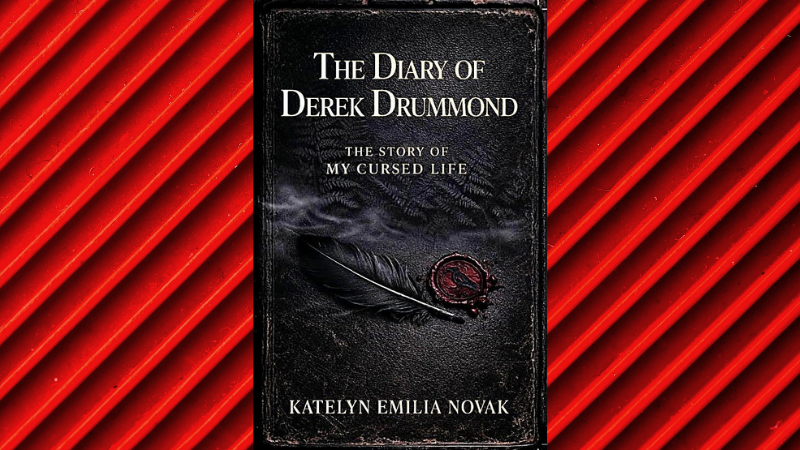
The Diary of Derek Drummond Q&A: Exploring Identity, Memory and Immortality
There are some novels that don’t simply tell a story — they pull you into a world and linger in your thoughts long after the final page. The Diary of Derek Drummond is one of them. Darkly poetic, emotionally intense and steeped in gothic atmosphere, it introduces readers to Derek Drummond, an immortal Scottish nobleman who has spent 124 years caught between day and night, hiding from the world — and from himself.
Set between the storm-lashed cliffs of northern Scotland and the rain-soaked rooftops of London, this atmospheric debut explores identity, memory, forgiveness and the terrifying hope of being truly seen. But when Megan MacKenzie looks at Derek and senses something beyond the carefully constructed mask he wears, the curse he’s lived with for more than a century begins to shift — and the past refuses to stay buried.

Written by entrepreneur and trained psychologist Katelyn Emilia Novak, the novel blends folklore, emotional tension and a strikingly intimate narrative voice, examining what happens when time stretches far beyond what the human mind was ever meant to endure.
We spoke to Katelyn about why she chose to tell the story entirely through Derek’s voice, how psychology shapes her writing, and the role that place and folklore play in creating literary tension.
Q1. Derek is such a layered protagonist—vulnerable, ironic, and clearly haunted. What drew you to writing a character like him, and what did you want readers to understand about him beneath the darkness?
What drew me to Derek was precisely that tension between strength and fracture. I have never been interested in writing a hero who is simply dark for the sake of being dark, or mysterious in a decorative way. I wanted to create a man whose irony, reserve and intelligence are not stylistic traits, but forms of self-protection. Derek is haunted not only by what has happened to him, but by what time does to love, identity and memory. He has lived too long with pain, and when people live with pain for long enough, they rarely express it directly. They turn it into wit, distance, control, even coldness.
What mattered to me most was that readers should sense the humanity beneath his darkness. Derek is not cruel, and he is not emotionally empty. On the contrary, he feels deeply, but he has learned to conceal feeling because that is how he survives. Beneath the restraint, there is tenderness, grief, longing, and, perhaps most importantly, a desperate need to remain fully human in circumstances that are constantly trying to strip that humanity away. I wanted readers to understand that his darkness is not the whole of him. It is the surface formed by suffering. Underneath it is a man still capable of love, loyalty, irony, vulnerability and hope.
Q2. You originally began writing the book from a female point of view but later rewrote the entire story through Derek’s voice. What sparked that decision, and how did changing perspective transform the emotional heart of the novel?
That was one of the most important creative decisions I made. When I first approached the story, I began from a female point of view because, in many ways, that felt like the more expected route into a gothic romance. But the deeper I went, the clearer it became that the true emotional gravity of the story lived inside Derek. His voice was stronger, more distinctive, more psychologically complex, and once I heard it properly, I realised the novel could not fully breathe without it.
Rewriting the book through Derek’s perspective transformed everything. It gave the story a very different emotional temperature. Instead of observing the mystery from the outside, the reader is placed inside the consciousness of the man carrying the curse, the memory, the grief, and the long burden of time. That shift made the novel more intimate, but also more psychologically layered. Derek’s voice allowed for a more unusual balance of darkness, irony, restraint and longing. It also made the love story more powerful, because it is not simply about being loved; it is about whether someone who has suffered for so long can still recognise love when it returns.
In many ways, the novel only became itself when I changed perspective. Derek gave it its tone, its rhythm, and its emotional truth.
Q3. As a trained psychologist, you clearly have a deep understanding of human behaviour. How has your professional insight influenced the way you write emotional tension, trauma, and the inner contradictions of your characters?
My background in psychology has influenced my writing enormously, though perhaps not in the most obvious way. I am not interested in turning fiction into case studies, nor in explaining characters too neatly. In real life, people are rarely consistent, transparent or easily interpreted. They contradict themselves constantly. They want one thing and fear it at the same time. They love and resist, long and withdraw, remember and distort. That complexity is what interests me most in fiction.
Psychology has taught me to pay close attention to what is not said, to the gap between behaviour and feeling, and to the many subtle ways people defend themselves against pain. Emotional tension, for me, rarely comes from dramatic declarations. It comes from restraint, avoidance, displacement, irony, silence—those moments when a character reveals more by what they cannot say than by what they do say.
It has also shaped the way I approach trauma. Trauma is not only an event; it is something that changes perception, relationships, trust, and even the structure of inner life. People who have suffered deeply often develop highly sophisticated emotional strategies just to keep going. That is certainly true of Derek. His contradictions are not flaws in construction; they are part of his truth. I think my psychological training made me more patient with ambiguity, and more committed to writing characters as emotionally real human beings rather than as archetypes.
Q4. Your writing explores identity, memory, and emotional truth—themes that feel especially powerful in a story about immortality. Why do you think immortality is such a compelling lens through which to explore the human psyche?
Immortality is compelling because it magnifies the questions that already haunt ordinary human life. Who are we over time? What remains of us after grief, loss, regret, and change? How much can a person endure before memory itself becomes a burden? We often imagine immortality as power, but psychologically it can be read as an exposure. It removes the mercy of limitation. It forces a person to live not only with desire, but with repetition, memory, guilt and emotional accumulation.
That is what interested me in Derek’s story. I was far less interested in immortality as fantasy than in immortality as psychological pressure. What happens when a person cannot simply move on, because time does not release him? What happens when memory refuses to fade? What happens to identity when you have lived through too much, lost too much, and still have to keep existing?
For me, immortality becomes a lens through which to examine emotional truth in its rawest form. It strips away illusions. It exposes loneliness, longing, and the need for meaning. In Derek’s case, it also raises the question of whether love can still redeem a life that has been stretched almost beyond recognition. That, to me, is where immortality becomes most human—not in its supernatural dimension, but in the emotional and psychological cost it exacts.
Q5. Scotland’s northern landscapes, folklore, and atmosphere feel like a character in their own right in The Diary of Derek Drummond. How did place shape the tone of the book, and what is it about Scotland that lends itself so beautifully to gothic tension and mystery?
Scotland shaped the book at every level. It was never simply a setting for me; it was part of the novel’s emotional architecture. The northern landscape, with its stone, sea, wind, distance, ruins and sudden shifts of weather, naturally creates a feeling of exposure and mystery. There is beauty, of course, but there is also solitude, severity and something ancient that seems to outlast human certainty. That atmosphere is deeply compatible with gothic fiction, which so often depends on tension between the visible world and what seems to lie beneath it.
I was especially drawn to the way Scotland can feel both intimate and vast at the same time. A ruined chapel, a stretch of heather, a cliff edge, a castle in mist—these are visually striking images, but they also carry emotional weight. They suggest inheritance, silence, memory, and the persistence of the past. In a gothic novel, place should never feel decorative. It should intensify the psychology of the story. Scotland does that beautifully because it is a landscape that seems already charged with history, folklore and unanswered questions.
Its folklore also matters. Scottish tradition contains a richness of superstition, symbols, clan memory, and spiritual unease that lends itself naturally to mystery. But beyond folklore, there is something in the atmosphere itself—the austerity, the beauty, the melancholic grandeur—that makes it an ideal landscape for a story about love, curse, memory and survival. Scotland did not just house Derek’s story. It helped define its soul
Final Thoughts
With its haunting atmosphere, emotional depth and unforgettable voice, The Diary of Derek Drummond feels like the kind of story that stays with you, not just for its gothic romance and mystery, but for the very human truths beating beneath its supernatural surface. Katelyn Emilia Novak writes with insight, sensitivity and a fascination for what lies beneath the obvious, reminding us that even the most immortal of characters can still be undone by memory, love, and the desire to be truly seen.
If you’re drawn to stories rich in psychological tension, folklore, and darkly beautiful landscapes, this is a novel worth sinking into.

The Diary of Derek Drummond is available via Amazon and to order in good bookshops.
Poppy Watt
#Competition
We have 3 copies of The Diary of Derek Drummond to offer 3 lucky readers.
Here’s How to Enter:
- Follow the Women Talking Instagram Account
- Like & share the post.
- Make a COMMENT, stating why you would like to win – Anyone who comments will be entered into the prize draw to win.
- This competition has now closed.
GOOD LUCK!
*The editor’s decision is final and there is no cash alternative
*The competition is open to UK residents only.
*The winner will be chosen at random and notified on Instagram within 7 days of the contest closing date.
*This promotion is in no way sponsored, endorsed, or administered by, or associated with, Facebook.
*The winner will be contacted by DM on social media.