
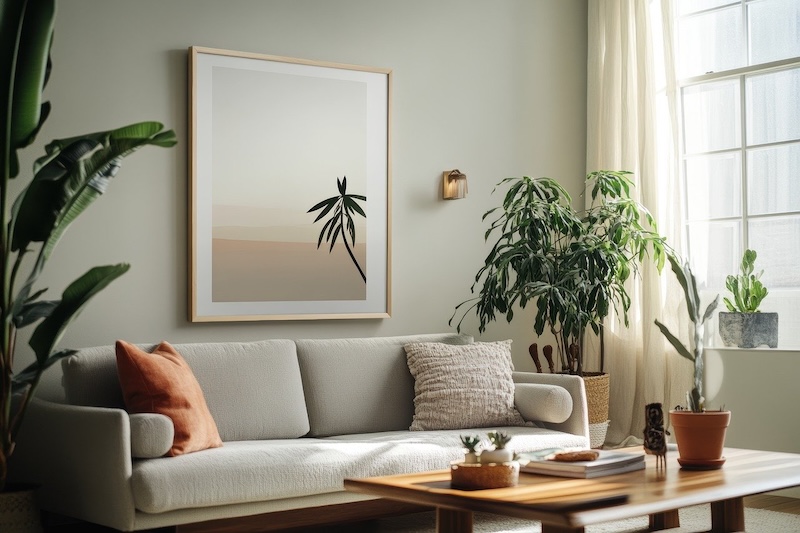
How to use prints to create visual zones without renovation – While for many homeowners and renters, an open-plan home with multi-purpose rooms is sought after due to its flow, openness, and flexibility, it can come with one concern. Homes with limited walls can lack a clear definition between rooms, resulting in spaces feeling cluttered and busy, no matter how minimalistic you try to keep things. This can be easily resolved without the need for renovation. The correct choice of furniture and decor, such as L-shaped sofas, rugs, and gallery wall art, will help you define your living areas to appear more intentional.
Now, upgrading your furniture and overhauling your decor can get a little pricey, but opting to create visual zones with prints and artwork will be simple, effective, and budget-friendly. When approached strategically, these framed designs help draw the eye, creating a subtle yet fruitful division from space to space. Understanding the scale, placement, and continuity between these pieces will allow you to build visual boundaries between your living, dining, and working areas.
Visual Zoning – What You Need To Know
To put it simply, visual zoning is the process of dividing your open plan space into multiple practical areas with the help of design elements. Rather than investing thousands in a renovation to add walls and partitions, you can create separation with homeware, as long as you have the right proportions, layouts, and finer details. Art is especially good at doing this as it naturally draws the eye and suggests effective focal points. This clearly showcases where one area ends and another starts – for example, transitioning from a living room into an eating nook. Your sofa may be complemented with one statement painting, while your dining table could sit in front of a collection of small prints and imagery.
Scale And Purpose
One of the most influential tools for visual zoning with art is the scale of your designs. The human eye instinctively uses the size of your framed pieces to interpret the function of the space, alongside the importance of it. Before colour, style, or subject matter are discussed, scale signals how an area should be read and used.
This is effective because:
- Scale anchors function to location, grounding the area it sits within.
- The size of your print will create instant hierarchy, communicating to the brain what area of the room is the focal point.
- Proportions will affect how spacious and transitional the various zones in your home feel.
- It defines the boundaries of rooms, starting and ending without interrupting the flow of an open-plan living arrangement.
- Scale helps reduce visual noise and clutter, preventing your home from feeling busy (this clarity is essential when multiple rooms exist within one space)
By simply adjusting the size of prints, it becomes possible to shape how a space is understood and used. When zoning with prints, scale is often the first and most effective decision, as it determines how every other element in the room will be perceived.
Defining Your Zones
When renovations are not an option, the layout, style, and placement of wall art become a prime way to create visual zones. These work hand in hand, allowing an open plan home to feel structured and intentional without disrupting its flow and the light.
We want to signal a boundary without closing off an area entirely, which is when gallery walls work their best. A collection of framed designs, thoughtfully placed together, occupies enough space to resemble a natural room divider. Positioned behind a sofa, hung alongside a dining table, or scattered around your desk, they distinctly define the start of a dedicated environment. Consider the layout of your gallery wall, as this will also influence how others perceive your home. Living rooms are best suited to asymmetrical layouts that create relaxed atmospheres, whereas formal dining rooms or work areas align with structured, symmetrical arrangements.
Equally important is how art complements your furniture. For example, the width of your gallery wall could align with the length of your sofa. Prints should come together with pieces that sit above or beside them, strengthening the relationship between elements in the room. Another important way to refine the zones in your open plan home is the theme, colour palette, and tone of the artwork.
Here are a few tips and tricks interior designers follow when planning open-plan living:
- Warmer tones encourage comfort and sociability, ideal for seating areas.
- Cooler, neutral palettes support focus in work or reading zones.
- Consistent background tones maintain cohesion across rooms.
- Vertical arrangements draw the eye upward, helping define zones in smaller, compact floor plans.

Used together, these techniques allow multiple zones to coexist clearly within a single, unified space.
Intentional and Flexible Interior Design
As preferences, lifestyles, and priorities change, flexibility is key. This is why using prints in your home suits just about anyone. Artwork can be easily removed, replaced, or added over time to support new looks and needs. This adaptability allows your home to develop with you, without huge alterations and disruptions. Better yet, it saves on costs too. To help open layouts feel more organised and purposeful, effective zoning with prints helps implement structure and clarity. Each zone feels complete in its own right, while still contributing to a cohesive, well-balanced overall space.
Art is a convenient, cheaper, and impermanent way to decipher how a room is experienced, not only by you, but also by your guests too.
Decorate your open-plan home with framed prints and treat your existing walls as a design tool. Wall art is more than a fun addition to a home; it provides a framework that sets a space up to flow and function beautifully, without needing to renovate.
Poppy Watt