

Tongits Online Game Guide: Signs Your Opening Hand Is Strong
Building an advantage in Tongits online game often begins before the first draw. A strong starting hand rarely means “many high cards” or “one card away from a big combo.” Hand quality usually comes from three practical factors: how quickly the cards can become valid melds, how many realistic upgrade paths exist as the round develops, and how much deadwood value remains if the game ends abruptly.

Beginners typically gain the most from learning the difference between cards that already work together and cards that only look promising. Experienced players also benefit from reviewing structure instead of judging a hand based on individual card values. The most useful lens is synergy—completed melds, near-melds, deadwood points, and flexibility against opponents’ discards.
Quick Guide: What defines a strong Tongits starting hand?
A strong opening hand features at least one completed set or run, additional connected cards that can realistically turn into more melds, and limited unmatched high-value cards. Flexibility matters: the best hands can pivot based on draws and discards rather than forcing a single plan.
1) Know the basics of the Tongits starting hand
Traditional Tongits uses a standard 52-card deck without jokers and is commonly played with three participants. The dealer starts with 13 cards, while the other two players receive 12 cards each. The remaining deck becomes the stock pile for draws.
Winning play centers on forming melds and minimising the point value of leftover unmatched cards when the round ends.
Two meld types shape every starting-hand evaluation:
- Set: three or four cards of the same rank (example: Q♣-Q♦-Q♠)
- Run: at least three consecutive cards of the same suit (example: 6♥-7♥-8♥)
Aces are treated as low in many Tongits rule sets, so a Q-K-A sequence does not count as a run. That single rule prevents many early mistakes when players try to “connect” high cards that do not actually form a valid sequence.
2) Prioritise cards that already form valid melds
Completed melds stand out as the most reliable sign of a good opener because they reduce deadwood immediately and give the hand a foundation. A suited 6-7-8 run is instantly playable, just as three 9s across different suits create an immediate set.
One important constraint affects evaluation: a card cannot be used in two melds at the same time. A 7♥ that holds together a 6♥-7♥-8♥ run cannot simultaneously serve as part of a three-7 set. A hand that appears to contain multiple combinations can become weaker once overlaps are removed.
3) Spot near-complete runs and sets with realistic completion chances
A promising starting hand does not require several finished melds. Many strong openings contain “builders”—two cards that can become a meld with the right draw.
Examples include:
- Two suited connectors: 4♦-5♦, which can complete with either 3♦ or 6♦
- A rank pair: K♠-K♦, which can become a set if another King appears
Not all near-melds are equal. Suited connectors often offer two direct completion targets, while a pair generally needs one specific rank. As the round progresses and cards are revealed through discards, some builders become less practical.
4) Watch unmatched high-value cards and your deadwood exposure
Starting-hand strength also depends on the points you might be forced to carry. Standard Tongits point values usually treat Aces as 1, number cards as face value, and J/Q/K as 10 points each.
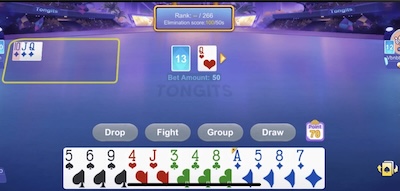
A starting hand containing several face cards that do not belong to any set or run can become dangerous fast. A loose K-Q-J trio, for example, can represent 30 points of deadwood if the round ends before those cards are melded.
High cards should not always be discarded immediately, especially if they support a developing set or a suited run plan. The practical question is whether the high-value card has a clear route to become part of a meld—or whether it functions mostly as risk.
5) Measure flexibility: how many ways can the hand improve?
A strong opening hand usually offers multiple improvement paths. Holding 7♣-8♣, for instance, provides two natural completion options: drawing 6♣ or 9♣. That type of flexibility generally outperforms hands made of unrelated cards that require a single exact draw to become useful.
Flexibility also includes knowing when to change direction. A plan built around a connector or a pair can lose value if the table’s discards suggest the missing cards are unlikely to appear.
6) Check for too much deadwood
Deadwood refers to cards that are not part of any meld. Tongits often rewards players who keep deadwood low and manageable, especially when rounds end unexpectedly.
Common starting-hand patterns and what they imply:
- Completed three-card run: strong, already counts as a meld
- Three of the same rank: strong, immediate set
- Two suited consecutive cards: promising, needs one connector
- Two of the same rank: promising, needs a third card
- Several disconnected face cards: risky, high deadwood potential
- Mostly unrelated low cards: limited, fewer realistic meld paths
7) Compare two sample starting hands
Examples help clarify how structure changes hand quality.

Hand A: 6♥, 7♥, 8♥, 5♣, 5♦, K♠, Q♦, 4♣, 9♣, 2♥, J♦, 3♠
Hand B: 2♠, 7♥, 9♦, J♣, Q♠, K♦, 4♥, 8♦, 3♣, 10♠, A♠, 6♣
Hand A begins with a completed 6-7-8 hearts run and also holds a pair of 5s that could become a set. Hand B has no completed meld, carries three face cards worth 30 points if unmatched, and relies on potential connections like A♠-2♠ and 8♦-9♦ for improvement. The comparison highlights why hand evaluation works better when meld structure and deadwood are judged together.
8) Use a five-step checklist before choosing discards
A systematic review can guide early decisions:
- Identify completed sets and runs
- Mark potential combinations (connectors and pairs)
- Separate truly unmatched cards
- Add up the point value of unmatched cards
- Consider availability based on exposed and discarded cards
9) Avoid common starting-hand mistakes
Misreads often come from predictable habits: overrating pairs as if they were finished melds, keeping every face card without a clear plan, overlooking suit connections, ignoring total deadwood points, refusing to pivot when needed cards appear unlikely, and treating a strong opening as a guaranteed win.
10) Applying these principles in Tongits GameZone

Players on platforms like Tongits GameZone can apply the same fundamentals: find completed melds, favor flexible builders, keep deadwood manageable, and evaluate risk before committing to high-value unmatched cards. Because mechanics and end conditions can vary by app version, checking the latest Tongits Plus rules inside the platform helps align strategy with current scoring and round-ending triggers.
FAQs
What counts as a good starting hand in Tongits?
Completed melds, workable connectors or pairs, and low unmatched high-card exposure.
Are three suited consecutive cards always strong?
A valid run reduces unmatched cards immediately and typically improves early stability.
Should pairs be kept?
Pairs can be worth keeping when the third matching rank remains realistically obtainable.
Are low cards always better than high cards?
Lower points reduce risk, but high cards can be valuable when they fit into real meld paths.
Daisy Sparks