
The Art of Feeling Good: Why Women Are Rethinking Wellness.
For years, wellness has sometimes felt less like a way of feeling good and more like another thing women are expected to be good at.
The perfect diet. The perfect morning routine. Supplements, exercise, meditation, cold showers, fasting and sleep tracking. And if we’re not doing all of these things, perhaps we’re simply not trying hard enough.
But maybe wellness was never supposed to feel like hard work.
There is a noticeable shift taking place in how women think about health and wellbeing. Increasingly, we’re looking for approaches that feel realistic, enjoyable and sustainable rather than restrictive. We’re becoming more interested in supporting our bodies rather than constantly trying to “fix” them.
At the same time, we’re looking back to traditional approaches to health and wellbeing, with ingredients such as functional mushrooms and botanicals being brought into modern formulations and considered alongside contemporary research.
It is this combination of traditional ingredients, modern science and a more pleasurable approach to wellness that caught our attention at Aiku Labs.
Wellness without the rules
Aiku is a UK wellness brand built around a simple idea: feeling good is the baseline.
Its philosophy, “The Art of Feeling Good”, challenges the idea that wellness has to involve perfection, restriction or an endless list of rules.

For founder Foyin Fagbemi, this is personal.
“Wellness culture has told women for years that feeling good is something you earn through discipline, restriction, and doing everything perfectly,” she explains.
Foyin experienced that mindset herself, becoming deeply involved in veganism after reading Michael Greger’s How Not to Die and pursuing the idea that being stricter about her lifestyle would automatically mean being healthier and living longer.
“What I actually found was that rigid rules make wellness feel like punishment,” she says. “And if feeling good requires suffering, I don’t think it’s actually wellness at all.”
Aiku’s answer is what it calls a “no-isms” approach: no judgement, no shame and no expectation that you have to completely overhaul your life before you are allowed to feel better.
Instead, the focus is on small, consistent forms of support.
Ancient ingredients, modern thinking
Functional mushrooms are a good example of the way traditional wellness is finding a place in today’s health conversation.
Mushrooms such as Lion’s Mane and Reishi have long histories of traditional use, while modern researchers continue to investigate their properties and potential applications.
Of course, traditional use isn’t the same as clinical proof, and not every claim made about a “natural” ingredient is automatically supported by evidence. Today’s more informed wellness consumer wants to know where an ingredient comes from, why it is being used, how much is included and what research exists.
That balance between tradition and modern evidence is central to Aiku’s approach.
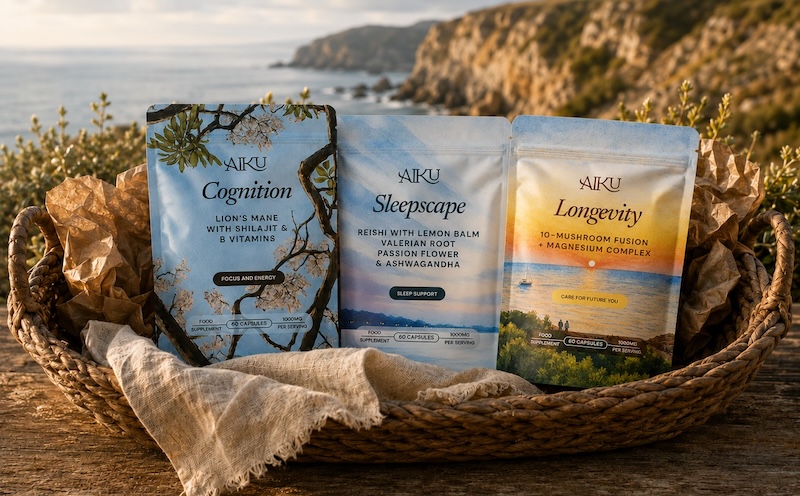
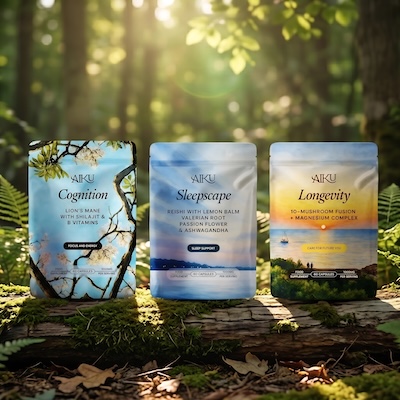
Its core range includes Cognition, Sleepscape and Longevity.
Cognition combines Lion’s Mane with B vitamins and is designed around focus and cognitive support. Sleepscape brings together Reishi and Ashwagandha, while Longevity contains ten functional mushrooms alongside bioavailable magnesium.
Aiku says its formulas are clinically researched, transparently dosed, manufactured to global compliance standards and third-party tested.
Supplements don’t have to look clinical
But Aiku isn’t only interested in what’s inside the pouch.
Its packaging features landscape photography from around the world, including Ibiza, Greece, New York, Lagos and Uganda.
“We have refused to accept that supplements have to look clinical to be taken seriously,” says Foyin.
She wanted the packaging to create a sense of presence and connection with the wider world.
“I want people to hold a pouch and think ‘someone stood in this location and took this picture, and now a piece of that memory sits on my table. What a wonderful world it is!'”
It is a small detail, but it perfectly reflects the brand’s pleasure-first philosophy.
Bringing pleasure into women’s wellness
Aiku’s next development is perhaps its most intriguing.
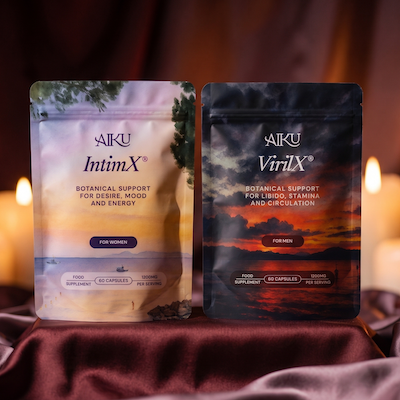
Launching this October is the Pleasure Range, including IntimX and VirilX, with pre-orders opening in September.
IntimX is designed around women’s intimate wellbeing, an area that has often been overlooked or approached rather awkwardly in the wellness industry.
“We talk openly about sleep, about focus, about gut health and longevity, but desire gets treated as something separate, something to be embarrassed about, or worse, something clinical and joyless when brands do address it at all,” says Foyin.
“Especially when we are talking about women’s desire and libido.”
Her view is that intimacy and desire are legitimate parts of wellbeing and deserve the same openness and lack of shame as every other aspect of health.
And that feels particularly relevant as women become more willing to talk openly about ageing, hormones, sleep, cognitive health and changes in their bodies.
Wellness isn’t just about supplements
Perhaps the most interesting part of Aiku’s philosophy isn’t actually about supplements at all.
Foyin believes strongly in the importance of community, particularly as our increasingly individualistic lives can leave us feeling disconnected.
“We are building a community which I think is a very important aspect of Longevity,” she says.
It is a good reminder that wellbeing isn’t simply about what we eat, what we put into our bodies or how many steps we take.

It’s also about people, connection, experiences and enjoyment.
The new wellness: less perfection, more pleasure
What makes Aiku interesting is that it sits at the intersection of several conversations that matter to women today: functional mushrooms, evidence-led supplementation, sleep, cognitive wellbeing, healthy ageing and the increasingly open conversation around intimacy and pleasure.
But perhaps its biggest appeal is its rejection of the idea that wellness has to be another area in which women can fail.
You don’t have to be perfect.
You don’t have to follow every trend.
You don’t have to completely reinvent yourself.
Sometimes wellness can simply mean finding small, enjoyable ways to support yourself and remembering that feeling good isn’t something you have to earn.
That, after all, is The Art of Feeling Good.
Disclosure: Aiku Labs provided products for editorial consideration. As always, our opinions are our own.
Poppy Watt
✨ WIN YOUR FAVOURITE AIKU PRODUCT! ✨
We’re giving 5 lucky winners the chance to choose one product from the Aiku range to try for themselves! 💚
Whether you’re looking to support your everyday wellness routine, discover something new or simply fancy treating yourself, this is your chance to choose the Aiku product that appeals to you most.
To enter:
💚 Follow @womentalking1 and @aikulabs Instagram Accounts
💚 Like this post
💚 Tell us in the comments which Aiku product you’d love to try and why!
💚Sharing this post to your Stories or Feed isn’t required to enter, but we’d really appreciate it if you did to help spread the word!
Five winners will each receive one Aiku product of their choice. 🎁
Good luck! ✨ And don’t forget to tag a friend who might love to discover Aiku too!
This Competition has now closed.
https://www.womentalking.co.uk/why-women-are-rethinking-wellness/
Terms & Conditions
• Open to UK residents aged 18 years or over.
• The winners will be selected at random from all eligible entries.
• Winners will be contacted via DM from our official @WomenTalking1 Instagram account within 7 days of the closing date.
• If a winner does not respond within 7 days, another winner may be selected.
• No cash alternative or prize substitution is available.
• This giveaway is not sponsored, endorsed, administered by or associated with Instagram.
• Please beware of scam accounts. We will only contact winners from our official @WomenTalking1 Instagram account after the competition has closed and will never ask for payment or bank details.
• Full Terms & Conditions are available on our website.