
Feta: You Can’t Get Better – Is feta cheese something that you only tend to enjoy when on holiday in Greece? If so, I have some advice for you…enjoy it more often! I’ve always been a fan of feta and tend to include it in many of my everyday recipes, so when I had the chance to join an educational trip to the mountainous region of Achaea, Greece I was thrilled and felt honoured to be invited. And what an inspirational and educational trip it was.
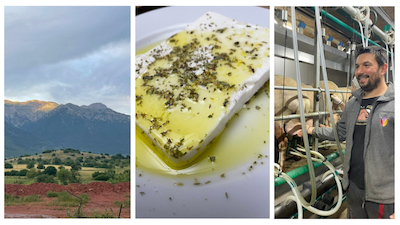
We were hosted by PDO Feta and the Agricultural Dairy Cooperative of Kalavryta. The Kalavryta area is known for its rich history, natural beauty, and cultural significance, it offers visitors an escape into a scenic landscape filled with forests, rivers, and majestic mountains. As someone who has enjoyed many holidays in the Greek islands, this area was a revelation, and I was amazed to discover that Kalavryta is also a popular ski resort. The town has a mixed history: it’s deeply tied to both the heroic Greek War of Independence and tragic events of World War II. These moments have shaped the town’s identity and left lasting marks on its cultural heritage. It was at the Monastery of Agia Lavra on March 25, 1821, that Bishop Germanos raised the flag of revolution, marking the official start of Greece’s fight for independence from the Ottoman Empire. Kalavryta also carries a heavy burden of memory from the events of World War II. On December 13, 1943, the town became the scene of one of the most tragic massacres during the Nazi occupation. In retaliation for resistance activity, German forces executed nearly all the male population of Kalavryta and burned the town to the ground. The massacre left deep scars on the community, but the resilience of the survivors is honoured through the Kalavryta Holocaust Museum and the Monument of the Fallen.
But the main focus of the trip was feta. Though the name feta is of 17th century origin and refers to the cutting of the cheese, it appears in far more ancient literature. A primitive form of feta is even mentioned in the Odyssey, where the hero Odysseus takes the cheese made by the cyclops Polyphemus whilst escaping from his cave. Today, feta is the flagship of Greece’s geographical indications and accounts for roughly 10% of Greek food exports, a testament to its outstanding international reputation.
According to PDO Feta its traditional production methods are linked directly to the specific climatic conditions of Greece. With its steep mountainsides and hot and dry climate, there was little land suitable for widespread cattle rearing. Instead, the Greek people turned to hardy sheep and goats that could thrive in these difficult conditions.
Though this might have made life hard in the past, it has given us contemporary consumers cause to celebrate. This is because the particular flavours of feta are only possible when sheep and goats are grazed on the unique flora of Greece. There are over 6000 different species of plants growing in the country, of which 15% are unique, a far higher proportion than many geographically larger nations. This biodiversity, when combined with traditional production methods, is a key reason for why true feta can only be made in Greece.
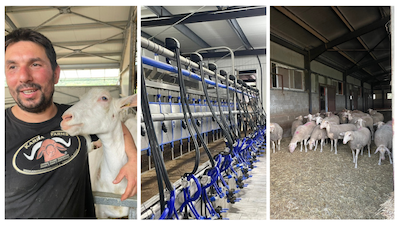
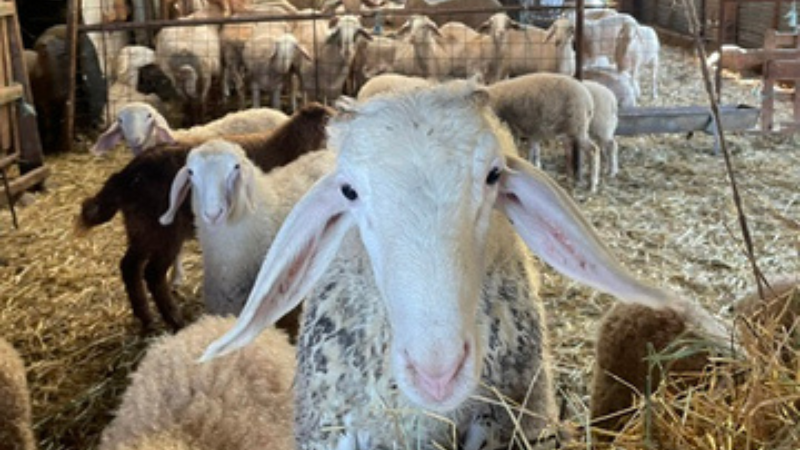
And so on the first morning, at ‘crack of sparrow’ we found ourselves at the livestock farm owned by a member of the cooperative, Andreas Karamouzis. Here we saw the sheep and goats lining up to be, and being, milked. PDO Feta has to have a milk ratio of 70/30 sheep/goat and Andreas told us that each sheep gives some 700 kg of milk each year. (In Greece they tend to use kg instead of litres for fluids, so you’ll find wine and water in restaurants being offered by the kilo). The livestock was obviously keen to be milked, and they’re also given food to chomp on while their milking takes place.
Andreas’s smallholding – with 200 animals – is just one of some 1200 that supply the cooperative with milk. In return, they are provided with machinery and other subsidised equipment. The cooperative is over 60 years old, and also manufactures its own feedstuff for the animals that’s sold to members at a reduced price. This not only helps the members, but ensures consistency of food quality, and hence the milk quality. The animals are milked twice each day and the milk is collected every day, frozen, and taken to the factory. There are strict regulations regarding the milk, such as not including any that is from an animal on antibiotics or other medication. It was clear to us that Andreas loves his livestock – we visited the pens (which allow free access to the open areas) and there were lots of gorgeous young kids and lambs that frolicked around and helped themselves to food from the storage area.
This farm was a smaller milk producer, and later we visited a much larger set up, owned by another cooperative member, brothers Andreas and Kostas Pavlopoulos. Their farm was nestled on the hillside of a beautiful glacial plateau, surrounded by mountains that have some 2,000 different herbs. The herds are escorted back for milking along the side road and kept in check by a number of sheepdogs that are bred by the farmers. As well as herding the animals, the dogs also ensure that snakes, wolves and other predators are kept away from the flock.
This farm had some five times more animals than the earlier one, hence more sophisticated equipment that sped up the milking process. After the visit we adjourned to the local restaurant “Sperchos” owned by the Pavlopoulos family, where we enjoyed a lovely dinner that also included their home produced wine and meats.

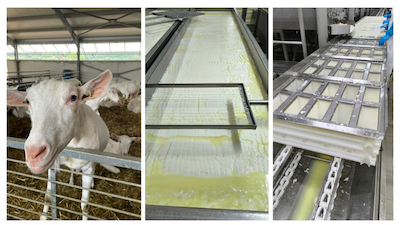
A visit to the production unit of the cooperative showed us that many strict regulations are enforced to ensure the quality and hygiene of the milk used in the process. On arrival, the milk is checked carefully and then pasteurised. A special culture and rennet are added and it’s transferred to tanks. Here the curds are separated from the whey and pressed into moulds.
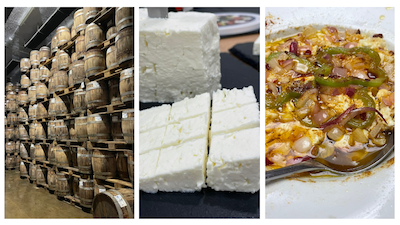
Traditionally these moulds have a large number of small holes, and no pressure is applied during the straining process. Once it has been removed from the moulds, the cheese is sliced and the surface is covered in a coarse-grained salt. During this stage, microorganisms develop on the surface of the curd which contribute to the flavours of feta. The ripening of the cheese takes place in two stages. In the initial phase, brine is added and the containers are placed in chambers under strictly controlled temperature conditions.
Salt is added as a preservative and flavour enhancer. The feta has to be matured for two months, and the barrel-aged feta for at least three to six months. The oak barrels literally towered above us in the maturation area. Some 30 tonnes of feta is produced by this cooperative every day for ten months of the year (July and August are left for maintenance and the breeding programme of the livestock).
Barrel-aged feta is cut into wedges, whereas the standard feta is in blocks. At the cooperative headquarters we tasted different types of feta, with the barrel-aged definitely having the edge with deeper flavour.
But as I found out on my trip, all PDO Feta is really delicious, and I would urge you to explore using more feta in your everyday recipes. It’s the true taste of a Greek summer, of course, in the ubiquitous traditional Greek salad, but there is a whole world of other uses that I will soon share with you with some recipes.
The Seasoned Gastronome