
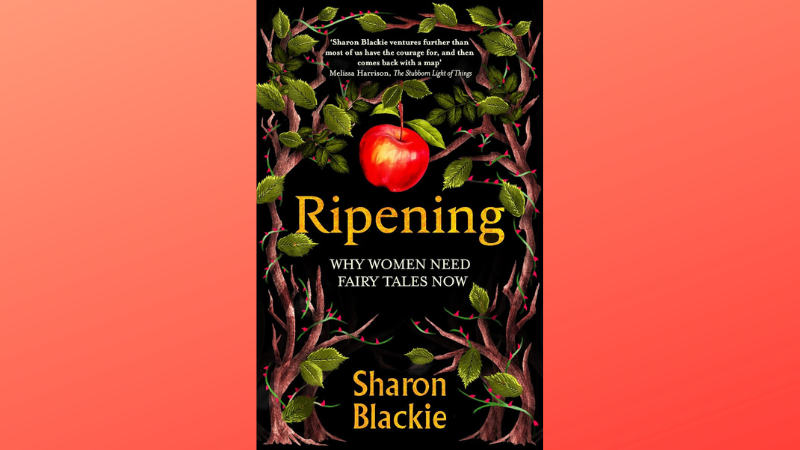
Ripening: Why Women Need Fairy Tales Now – Dr Sharon Blackie
(Published by September Books, 24 May)
As Women Talking’s holistic writer, I am often drawn to books that feel less like something to be consumed and more like something to be sat with, preferably with a cup of tea, a notebook, and the quiet sense that something inside you is shifting.
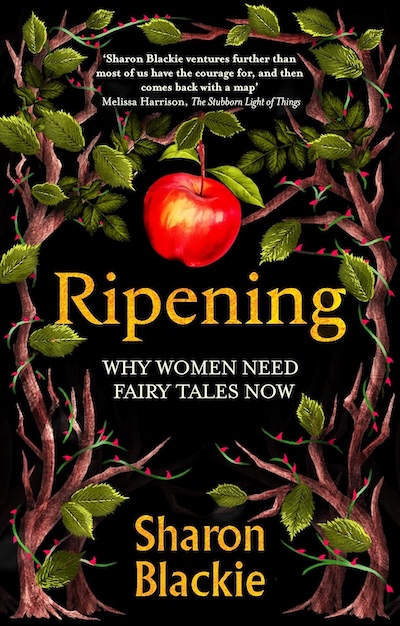
Ripening: Why Women Need Fairy Tales Now by Sharon Blackie is exactly that kind of book.
If you have read her earlier works, particularly If Women Rose Rooted or Hagitude you will recognise her voice immediately: intelligent yet earthy, mythic yet grounded, fierce yet compassionate. As a Jungian psychologist and cultural mythologist, Blackie has long invited women back into relationship with the old stories. In Ripening, she makes perhaps her most compelling case yet: that fairy tales are not childish escapism, but survival guides for women living through unstable times.
And unstable times we are certainly living in.
What moved me most while reading Ripening was Blackie’s insistence that the original fairy tales were never about passive princesses waiting to be saved. Before they were sanitised and commercialised, these stories carried something wilder. Their heroines are clever. Resourceful. Brave. They venture into forests, confront wolves, cross thresholds, endure exile, and emerge changed. They rescue themselves and often others too.
As someone who writes about wellbeing, I found this reframing deeply nourishing. So much of modern self-help culture encourages women to be endlessly accommodating, endlessly “nice.” Blackie gently but firmly dismantles that narrative. Fairy tales, she argues, teach reciprocity, relationship, and moral courage — but they also celebrate discernment, boundaries and, yes, a certain necessary feistiness. Being pleasant is not the same as being powerful.
The title itself — Ripening — feels important. Not blooming. Not fading. Ripening. It speaks to the long arc of a woman’s life, from adolescence through motherhood (or not), through perimenopause and into elderhood. There is something profoundly affirming in Blackie’s reminder that growth does not end with youth. In fact, in many of these tales, wisdom deepens with age. The older woman is not sidelined; she is often the keeper of knowledge, the shapeshifter, the guide.
Blackie draws on archetypal psychology, myth, folklore and neuroscience, yet the book never feels academic or inaccessible. It feels like sitting by a hearth while someone wiser hands you stories that have been carried across generations. Stories shaped by women who also lived in dangerous, uncertain times.
I was particularly struck by her assertion that fairy tales offer “the meaning that we’ve lost.” In a world of rapid change, social fragmentation and relentless noise, returning to stories rooted in relationship, with land, with community, with inner life, feels quietly radical. There is something deeply healing in remembering that women have always faced perilous landscapes and have always found ways through.

For readers who enjoyed reflective works such as Wintering by Katherine May, this will feel like a natural companion, though Blackie’s terrain is perhaps more mythic, more archetypal, and unapologetically fierce.
This is not a book you rush. It is one you underline. One you return to at thresholds. One you gift to a daughter, a sister, a friend stepping into a new chapter.
As I closed the final pages, I felt steadier. Reminded that within each of us lives the forest-walker, the truth-teller, the woman who refuses to shrink. Fairy tales, Blackie shows us, are not relics of childhood. They are maps.
And right now, many of us are looking for exactly that.
Lilly Light